
Behind every beautiful staircase is something far more important than design — structure. While finishes, railings, and materials often get the attention, the real success of any project lies in proper staircase construction and the integrity of the staircase structure beneath it.
Understanding how a staircase is built not only protects safety, but also ensures durability, code compliance, and long-term performance.
Why Staircase Structure Matters
A staircase is a load-bearing system. Every step transfers weight through the treads, into the stringers, and down into the home’s framing. When staircase construction is done correctly, the load is evenly distributed and movement is minimized.
When it’s not, issues appear quickly:
- Squeaking treads
- Bouncy steps
- Separation at landings
- Loose rail systems
The visible parts of a staircase are only as strong as the staircase structure supporting them.
The Core Components of Staircase Construction
To understand staircase framing, it helps to break the system down into its essential structural components.
- Stringers
Stringers are the backbone of staircase construction. These angled structural members support the treads and risers. Typically cut from solid lumber or engineered materials, stringers carry the majority of the load.
Precision is critical. Poorly cut stringers compromise the entire staircase structure, affecting both safety and appearance.
- Treads and Risers
Treads (the horizontal step surface) and risers (the vertical backing) must be securely attached to the stringers. In professional staircase framing, fasteners and adhesives are often used together to prevent movement and noise over time.
Proper spacing and consistent rise-and-run measurements are also essential for building code compliance and safe use.
For reference, stair geometry standards are outlined by the International Residential Code (IRC), which you can review through the International Code Council (ICC) website for technical guidance on residential stair requirements.
- Landings and Support Framing
Landings serve as transition points and structural anchors. In many homes, the landing ties directly into floor framing systems, strengthening the overall staircase structure.
Without proper support at landings, even well-built stringers can shift over time.
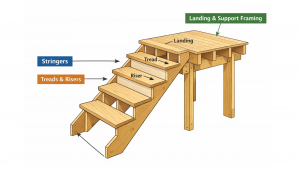
A detailed staircase construction diagram highlighting stringers, treads, risers, landing, and support framing.
The Role of Staircase Framing in Safety
Staircase framing must align with the home’s structural system. This includes anchoring the staircase securely at both the top and bottom, ensuring lateral stability, and accounting for load transfer.
Professional staircase construction includes:
- Proper header support at the upper floor opening
- Secure anchoring into subfloor and framing members
- Reinforcement to prevent twisting or deflection
A staircase structure that isn’t correctly integrated into the home’s framing can create long-term issues that are costly to repair.
Materials Matter in Staircase Construction
Modern staircase construction may use solid hardwood, engineered lumber, or steel reinforcement depending on design and span requirements. The choice of material affects durability, movement resistance, and long-term performance.
For example:
- Hardwood stringers provide strength and traditional durability
- Engineered lumber can reduce warping
- Steel reinforcement may be required for floating or open-concept designs
Each decision influences the integrity of the staircase structure.
Why Professional Staircase Construction Is Critical
Because staircases are structural systems, precision matters. Small measurement errors in staircase framing can multiply across the full run, affecting safety, comfort, and code compliance.
While cosmetic updates like painting, staining, or refinishing treads can be suitable DIY projects, the underlying staircase structure should never be approached casually. Staircase construction involves exact rise-and-run calculations, secure anchoring, load distribution, and strict adherence to building codes. Even minor miscalculations can lead to long-term structural issues or safety hazards.
Professional staircase construction ensures:
- Accurate rise-and-run measurements
- Proper load distribution
- Secure structural anchoring
- Long-term durability
More importantly, it ensures the staircase structure performs reliably for decades.
Building From the Inside Out
A staircase may appear decorative, but it is fundamentally structural. True craftsmanship begins with sound staircase construction and careful staircase framing before any finishing touches are added.
At Beach City Stairs, we specialize in professional staircase construction, staircase renovation, and stair repairs designed for long-term durability and safety. Whether you’re building new, updating an outdated design, or addressing structural concerns, our team delivers precision craftsmanship from the inside out.
Ready to get started? Contact us today for a free quote and let’s build a staircase that’s as strong as it is beautiful.